


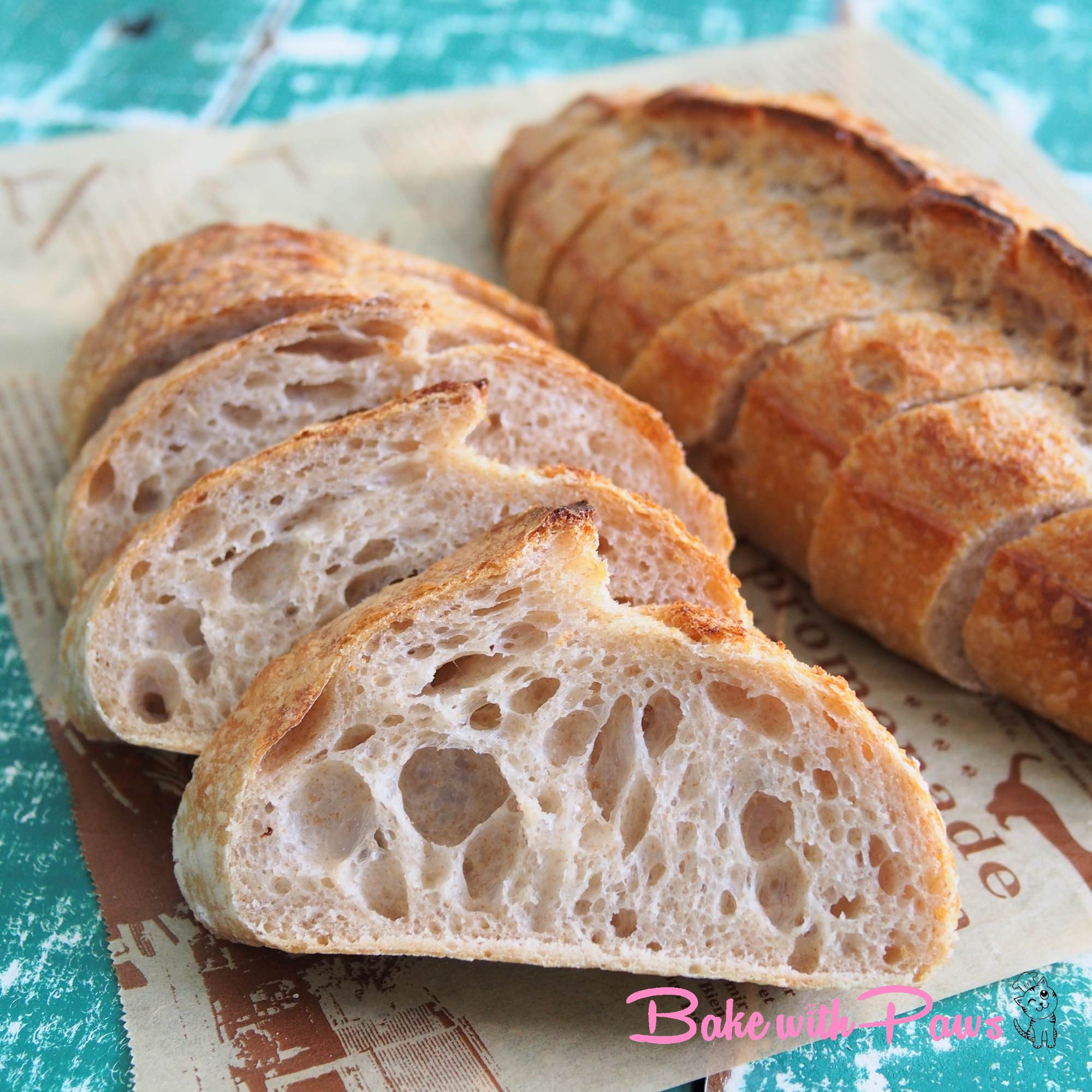
I have been wanting to bake smaller batards as it is nice size to slice. This is my 6th attempt. I tried different shaping and baking methods and this is the best that I could achieve so far. I will continue trying to improve and will share any new findings in future.
I baked these in steam with my home oven, using the technique learned from The Perfect Loaf. Baking in a cast iron pot will be easier and the result is more predictable. However, it will take a longer as I will only be able to bake one loaf at a time.
I am sharing this recipe as a reference. This recipe and method worked for me but it may not work for everyone.
If you have any questions regarding this recipe or any other post, please leave me a comment in the “LEAVE A COMMENT” link and I will reply you as soon as possible.
Recipe - Sourdough Batard
- Feed starter - I fed my starter before go to bed at ratio of 1:10:10 (starter:water:flour) and use the next morning when its peaks (around tripled).
- Autolyse - Mix flour and water, stir until there is no more dry flour with a spatula and clean the side with a scrapper. Cover and leave for 1 - 2 hours at room temperature (28C - 30C). After 1 - 2 hours I checked the window pane stage. The dough was very extensible when I pulled on it.
- Levain - Wet your hand, add 70g sourdough starter to the dough and hand mixing until incorporated, about 3 - 4 minutes. Cover and rest for 30 minutes.
- Sea Salt - Dilute sea salt with the balance of 10g water. Pour on top of the dough, use hand to mix in the sea salt water. It takes about 5 minutes until it is fully incorporated. Cover and rest for 15 minutes.
- Stretch & Fold - Pull and fold the dough 5 - 6 times. Round it up with the smooth top facing up. Put dough in a new dish (square pyrex dish). The reason to use a square dish is because it is easier to judge how much the dough has spread. Cover and rest for about 30 - 45 minutes or until dough spreads.
- Coil Fold 1 - At this stage, the dough is weak and extensible. Fold the dough in the dish. Cover and rest for about 45 - 60 minutes or until dough spreads.
- Coil Fold 2 - At this stage the dough still extensible but stronger compare with the dough before the 1st coil fold. Fold the dough in the dish. Cover and rest for about 30 - 45 minutes or until dough spreads.
- Coil Fold 3 - At this stage, the dough is quite strong and not so extensible and will be the last coil fold. However, if the dough is still quite extensible and spread a lot, then you will need one or two more coil folds. Fold the dough in the dish. Cover and rest for 60 - 90 minutes or until dough rise 40 - 50% in size since you added the levain.
- Preshape - I rounded up the dough about 4.5 hours after adding in the levain. Transfer dough onto floured top and divide into 2 equal portions. Round up the dough and cover with kitchen towel. Rest for 20 minutes.
- Shaping - Please watch the "how to shape batard video". Tranfer the dough onto a parchment paper and place into the prepared proofing couche as shown in the diagram and video. Put in a a plastic bag.
- Proofing - Proof at room temperature for 10 - 15 minutes.
- Retard - Then retard overnight in the fridge (4C) for 12 - 16 hours. This bread is about 15 hours.
- Baking -
- Preheat oven with baking stone and lava rock at 250C (top and bottom heat) for 60 minutes before baking.
- After 45 minutes or 15 minutes before baking, pour hot water over the rolled up kitchen towel in a rectangular pan. Place inside oven next to lava rocks.
- Once the oven is ready, take dough out from the fridge. Transfer the dough (together with parchment paper) to a pizza scrapper. Score the dough.
- Try to act quick on the below steps to avoid the more heat of escaping.
- Open the oven door, slide dough (together with parchment paper) on baking stone.
- Place a baking tray on 1st top rack (above the baking stone) as heat shield.
- Pour hot water into the lava stone.
- Close the oven door immediately.
- Bake with steam for 12 minutes.
- Remove the lava stone, rolled kitchen towels and baking tray (as heat shield). Lower the temperature to 230C (fan-forced) and continue bake for another 13 - 15 minutes.
- Remove breads from oven. Slice the bread while it is still hot.

- Air-conditioner room - Rest the dough in air-conditioner room during bulk fermentation. I used this option sometimes. I turned on my air-conditioner when I added in levain and try to maintain temperature between 24C - 25C.
- Home oven (that's turned off) - Place ice cooler packs inside along with an ambient temperature thermometer. Then place your dough during bulk fermentation in the oven. Keep an eye on that thermometer and try to keep between 24 - 25 C.
- Cooler bag - Place ice cooler packs inside a cooler bag. Then rest the dough inside the cooler bag during bulk fermentation. Try to maintain temperature 24C - 25C.